AI · · 7 min read
Meet Jev: the model that decides which model you can afford.
A new kind of AI model does not write a word. It makes decisions, in milliseconds, for almost nothing. That makes it a natural fit for one expensive problem: choosing the right LLM for every request.
By Precision Code Studios, Engineering team
Most teams running AI in production make the same quiet mistake. They pick one large language model, usually a very capable and very expensive one, and send it everything: the hard legal question and the request to turn a date into a different format, the tricky refactor and the one-word classification. It works. It is also like hiring a senior architect to sort the post.
The obvious fix is to send easy work to a cheap model and hard work to a strong one. The trouble has always been the sorting. Something has to read each request and judge it, and if that something is another large model, you have added cost and delay to save cost and delay. In September 2026 a new kind of model arrived that changes the arithmetic.
What Jev is
Jev comes from TypeSafe AI and opened in early access on 15 September 2026. Its makers call it a System One model, borrowing the psychologist Daniel Kahneman's name for fast, intuitive thinking, as opposed to the slow, deliberate kind that large language models imitate. The distinction is practical. Jev does not generate text at all. You hand it a block of state and a set of typed questions, and it hands back typed answers with probabilities attached.
- Choice. Pick one option from a fixed list, with a probability for each option.
- Score. Rate something on an ordered scale that you define.
- Yes or no. The probability that a statement is true.
Because the answer can only ever be one of the options you supplied, there is nothing to parse and nothing to go off script. According to TypeSafe, a decision returns in roughly 70 to 500 milliseconds, and at launch the price was $0.042 per million input tokens with no charge for output. Those are the vendor's figures, and early-access pricing can change, but the order of magnitude is the point: decisions become cheap enough to make on every single request.
- 0 Words generated: it returns typed decisions
- 70 to 500 ms Per decision, as stated by the vendor
- $0.042 Per million input tokens at launch
- 3 Answer types: choice, score, yes or no
Why calibration is the real feature
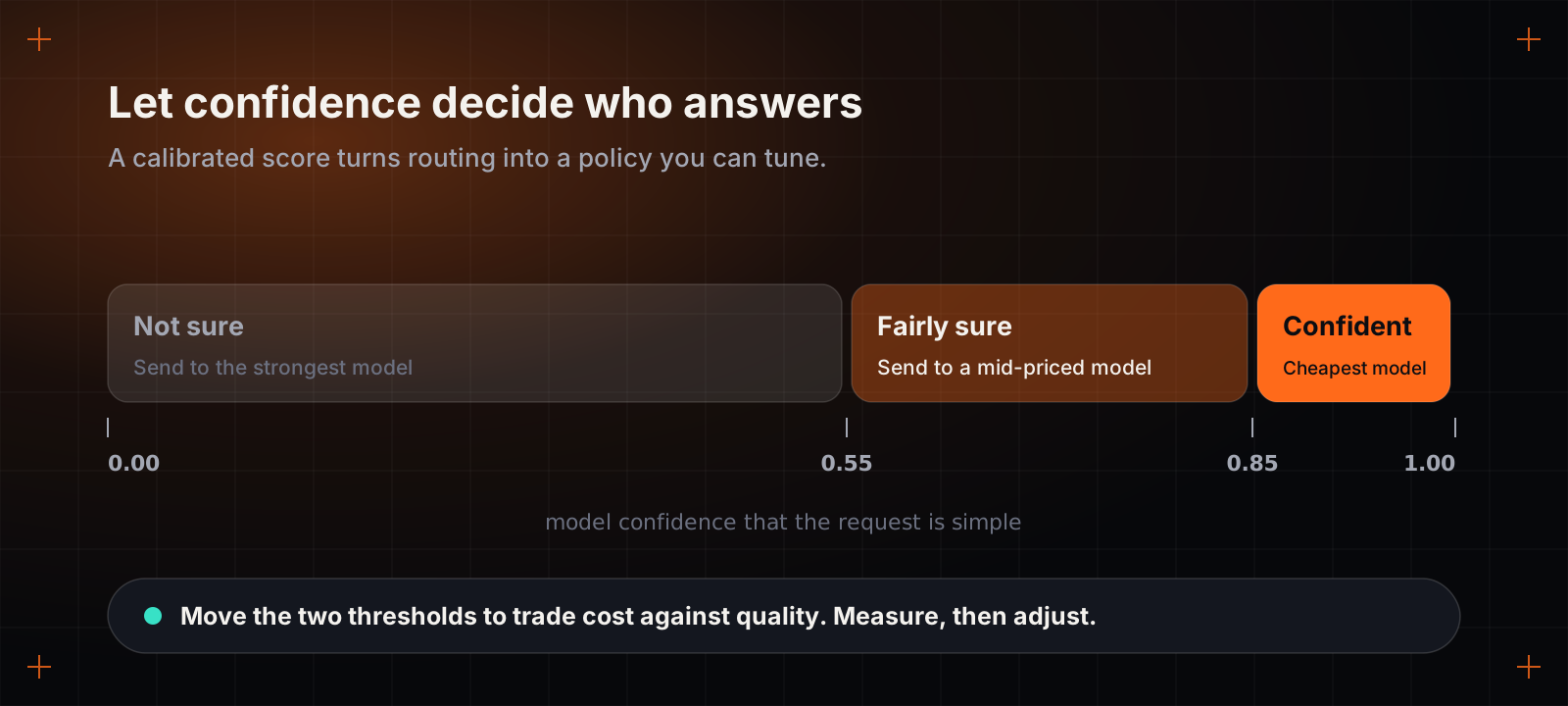
Speed and price get the headlines, but the property that matters for routing is calibration. A calibrated model's probabilities mean what they say: across many decisions where it reports 80 percent, it should be right about 80 percent of the time. That turns a guess into a dial. You are no longer asking whether the router is right. You are choosing how sure it must be before you trust it.
Using it to select an LLM
The pattern is simple. Before a request reaches any language model, a decision model reads it and answers a few questions you have written. Is this a lookup or does it need reasoning? How many steps will it take, on a scale of one to five? Does it involve code, law or money, where a wrong answer is costly? The answers, and the confidence behind them, choose the destination.
- Confident it is simple: send it to the cheapest model that handles that kind of task.
- Somewhere in between: send it to a mid-priced model.
- Hard, risky or uncertain: send it to the strongest model you have, which is exactly what you were doing with everything before.
The important design choice is the last line. When the router is unsure, it fails upward to the capable model. The worst outcome of a routing mistake is then the price you were already paying, not a bad answer to a customer.
What the arithmetic looks like
Take a round, illustrative example rather than anyone's real price list. A product handles a million requests a month at about 2,000 tokens each, on a premium model costing $10 per million tokens. The bill is $20,000. Suppose a decision model reads the first 800 tokens of each request to route it. At the launch price that costs about $34 for the whole month. If it sends six requests in ten to a model at a tenth of the price, the bill falls to roughly $9,200.
Your numbers will differ, and the share of traffic that is truly easy varies enormously from one product to the next. The way to find out is to measure it: replay a sample of real requests through both models, compare the answers, and let the evidence set the thresholds.
Beyond routing
- Guardrails. Is this request in scope? Does this reply contain something it should not? A fast check on the way in and the way out.
- Tool choice. Deciding which tool an agent should call is a classification problem, and need not cost a full model turn.
- Caching. Is this question the same as one already answered? If so, skip the model entirely.
- Escalation. Does this conversation need a human? Decide it consistently, with a threshold you can audit.
Where to be careful
A decision model is a specialist, and it is new. It cannot write, plan or hold a conversation, and its makers say plainly that exact arithmetic, date calculations and threshold comparisons belong in ordinary code. Independent reviewers have noted that it gives up some accuracy against larger models in exchange for its speed and price. It is a proprietary service in early access, with no published weights or research paper, so treat it as a dependency that could change. And it only reads text.
None of that weakens the idea. Whether the decision comes from Jev, from a rival that will surely follow, or from a small model you train yourself, the principle will outlast the product: stop paying your most expensive model to make your cheapest decisions.
How to try it this month
- Log a week of real requests. With what each one cost and which model answered.
- Label a sample by difficulty. A few hundred is enough to start.
- Put the router in shadow mode. Let it decide without acting, and compare its choices with your labels.
- Switch on the safest band first. Route only what it is most confident about, and keep failing upward.
- Watch quality and cost together. A saving that customers notice is not a saving.