Security · · 7 min read
What a penetration test actually finds.
Not film-style hacking. The same handful of ordinary mistakes, in almost every system, and the way they join up into something serious.
By Precision Code Studios, Engineering team
People imagine a penetration test as a duel of geniuses: an attacker in a dark room defeating layers of clever defences with something nobody has ever seen before. The reality is less cinematic and more useful. Most ways into most systems are not new. They are the same small set of ordinary mistakes, made by capable teams under deadline, waiting quietly to be noticed.
The usual suspects
- Access checks that are missing. The application confirms you are signed in, but not that the record you asked for is yours. Change a number in the address and you are reading someone else's invoice.
- Input trusted too easily. Text from a user ends up inside a database query or a command, and the system does what the text says.
- Secrets left lying around. Passwords and access keys in source code, in old commits, in configuration files and in build logs.
- Cloud storage open to the world. A bucket made public for one afternoon of convenience, three years ago.
- Software long out of date. Libraries and servers with published weaknesses and published fixes that were never applied.
- Doors that should not face the internet. Admin panels, databases and test systems reachable by anyone who looks.
- Permissions far wider than needed. A minor service that can read everything, so a small breach becomes a large one.
- Weak sign-in. No second factor, no limit on guesses, and password resets that can be tricked.
The finding that is not on any list
Automated scanners are good at spotting individual items like these, and every company should run one. What they cannot do is think like an attacker. A real intruder does not need a critical flaw. They need a path, and paths are built from things that look harmless on their own.
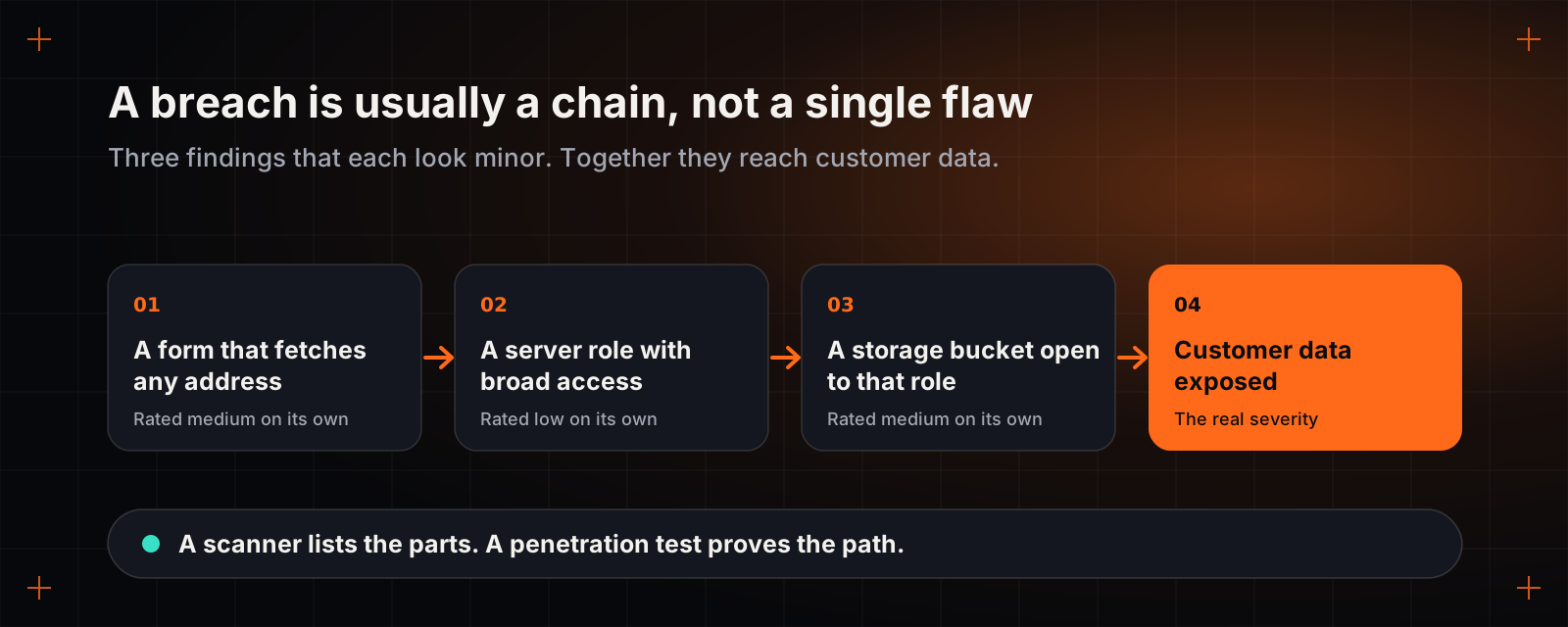
This is the real product of a penetration test: not a longer list than the scanner gave you, but proof of which combinations actually lead somewhere, demonstrated safely, before someone hostile works it out.
What a good report gives you
- Evidence. What was done and what came back, so nobody has to take the finding on trust.
- Severity in business terms. Ranked by what an attacker could reach, not by a generic score alone.
- The path. How individual weaknesses were combined, step by step.
- The fix. Specific enough for an engineer to act on the same day: the file, the setting, the change.
- A place to start. What to do today, this week and this quarter.
Where automation and AI change the picture
The traditional limit of a penetration test is time. A small team has a fixed number of days and must choose where to look. Automation, and increasingly AI, widens that window: more of the code read, more of the network mapped, more combinations tried than people could attempt by hand. It does not remove the need for judgement. Someone experienced still has to set the objectives, decide which leads are worth pursuing, and confirm that a finding is real. Reach from the machines, direction from the specialists.
When to test
Before a major launch. After significant changes to how users sign in or how data is stored. When moving to the cloud or between clouds. Ahead of a compliance audit or a large customer's security review. And on a regular rhythm in between, because your systems change every week and so does what attackers know. A test is a photograph. It needs retaking.
The comforting news is in the list at the top of this article. Because most findings are ordinary, most fixes are too. Security is rarely lost to brilliance. It is lost to small things nobody went looking for.