Leadership · · 6 min read
Technical debt is a balance sheet. Start reading it like one.
Engineers say the code needs work. The board hears a request to stop delivering. A ledger of what you owe, what it costs and what to repay ends that argument.
By Precision Code Studios, Engineering team
Few phrases in business are used as often and understood as little as technical debt. To engineers it is the daily friction of working in code that was built in a hurry. To everyone else it can sound like a complaint, or worse, like a reason to pause the roadmap. The two sides talk past each other for years while the problem compounds.
The term was coined by the programmer Ward Cunningham as a deliberate financial metaphor, and the metaphor is better than most people who use it realise. Taken seriously, it gives a company a way to manage the problem with the same discipline it applies to money.
Principal and interest
A shortcut in software is a loan. You get the feature sooner, which is the cash. The principal is the work you skipped: the tests not written, the design not tidied, the old system not replaced. The interest is what that shortcut costs you every time you touch that part of the product afterwards: the extra days, the bugs, the careful workarounds. As with money, the loan itself is often a sound decision. What ruins companies is never looking at the interest.
- Deliberate debt. A conscious trade to hit a date. Healthy, provided someone writes it down.
- Accidental debt. What you find out later you did badly. Unavoidable, and a sign that the team is learning.
- Neglected debt. Software left to age: old frameworks, unsupported versions. It grows even when nobody touches it.
How to see what you owe
You cannot weigh code quality, but you can measure its effects. How long does a small change take to reach customers, and is that getting longer? How often does a release cause a fault? Which files change most often and are also the hardest to understand? Those hot spots are where interest is actually being paid. A messy module that nobody has opened in three years costs nothing today.
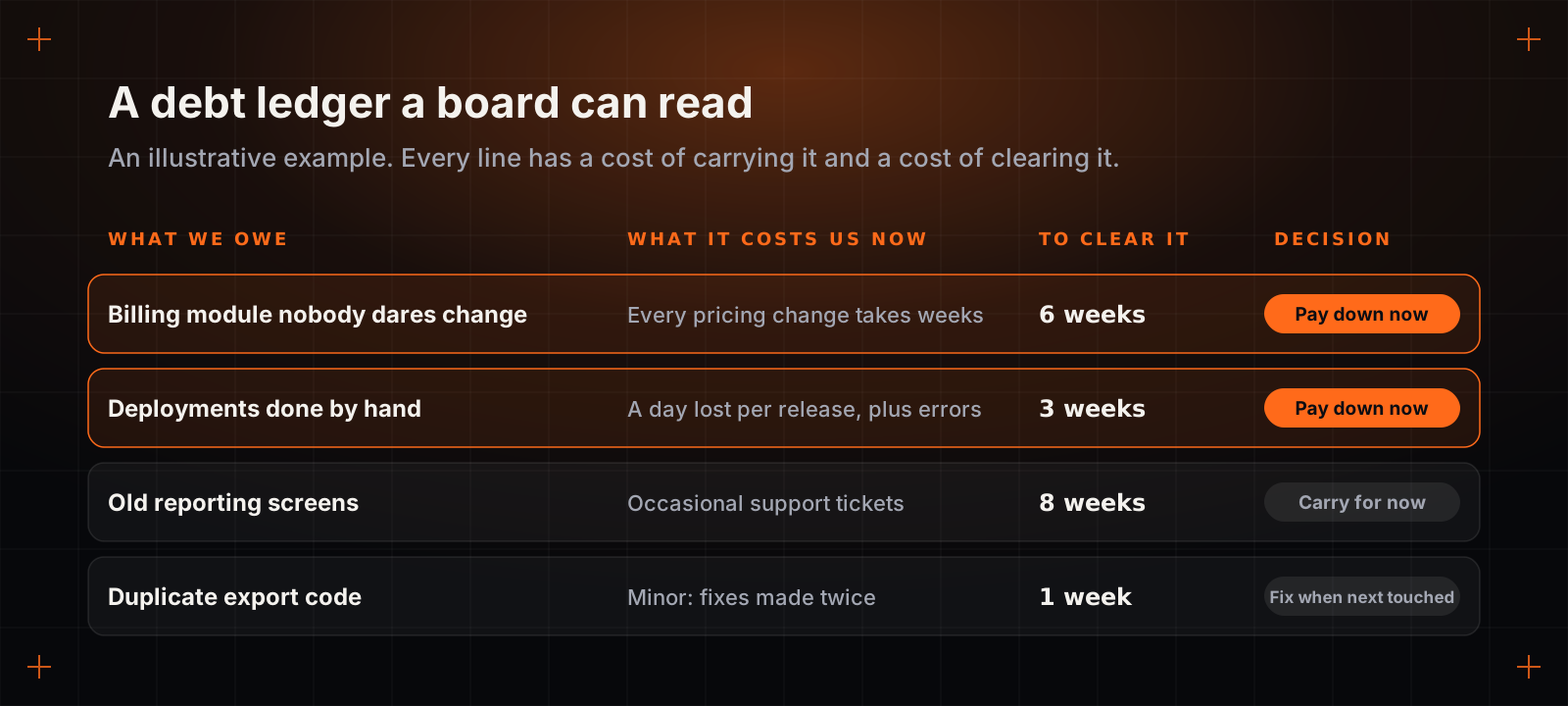
Presenting it to people who do not read code
Put each significant debt on one line with three facts: what it costs the business now, in delay or incidents or lost opportunity; what it would cost to clear; and what happens if it is left alone. Then make a decision per line. Pay down, carry knowingly, or fix when that part of the product is next changed. A board that would never approve a vague request to improve the code will readily approve six weeks to stop every pricing change taking a month.
A repayment policy that survives contact with deadlines
- Reserve a fixed share of every cycle. A steady allocation, set once, beats a clean-up project that is always next quarter.
- Repay where you are already working. Improve the code a feature touches, as part of that feature.
- Review the ledger quarterly. Debts change in cost. Some become urgent; some stop mattering.
- Never borrow silently. A shortcut is fine. An unrecorded shortcut is how surprises are made.
Debt is not the enemy of a software business. Unmanaged debt is. The companies that move fastest for longest are not the ones with spotless code. They are the ones that always know what they owe.