Mobile · · 7 min read
One codebase, every screen: the truth about cross-platform mobile.
Write once, run everywhere has been promised for decades. The modern frameworks finally come close. Here is what they deliver, what they do not, and how to choose.
By Precision Code Studios, Engineering team
Building a mobile product the traditional way means building it twice. One team writes the iPhone app in Swift, another writes the Android app in Kotlin, and from that day on every feature is designed once, built twice, tested twice and released on two schedules. The two apps drift apart, and so do their bugs.
Cross-platform frameworks offer a different deal: one codebase, one team, and apps for every platform from the same source. The promise is old and for years the results were disappointing. That has changed. Some of the most widely used apps in the world now ship this way.
The main options
- React Native. Written in JavaScript or TypeScript and rendered with the platform's own interface components. A natural step for teams that already build for the web with React.
- Flutter. Google's framework, written in Dart. It draws every pixel itself, so an app looks identical everywhere and custom design is easy.
- .NET MAUI. Microsoft's option for teams working in C#, sharing code with the rest of a .NET system.
- Kotlin Multiplatform. Shares the logic underneath while each platform keeps a fully native interface. Popular with teams that already have native apps.
- Capacitor and Ionic. A web application wrapped in a native shell. The fastest route when the product is mostly content and forms.
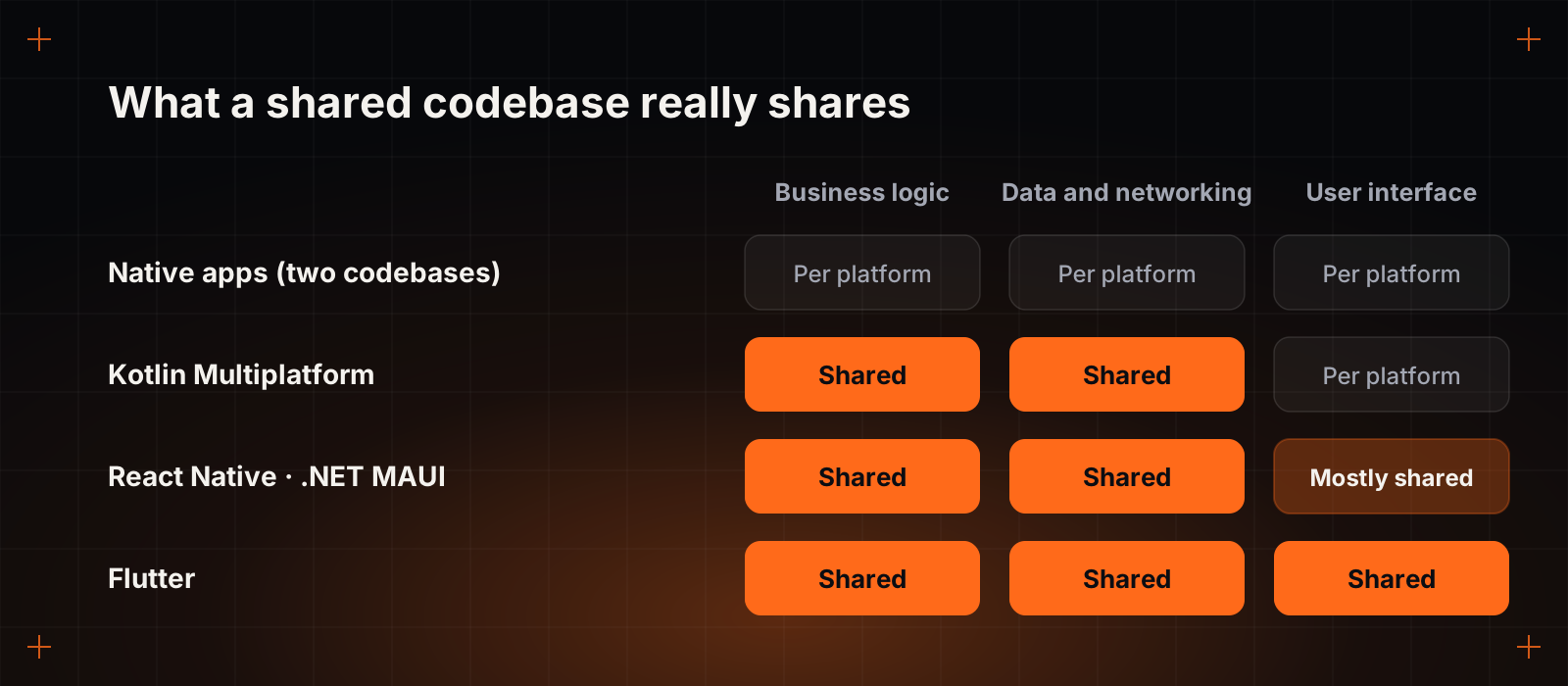
What you really get
The headline benefit is not saving code. It is having one team. One backlog, one release, one set of tests, one place where a business rule is written down. A feature reaches every customer on the same day, and a fix made once is fixed everywhere. For a company validating a new product, that can be the difference between launching this quarter and launching next year.
What write once does not mean
- You still test on both platforms. Real devices, both operating systems, several screen sizes. Shared code can still behave differently.
- Each platform has its own manners. Navigation, gestures and settings differ, and users notice when an app ignores them.
- New hardware features arrive natively first. The latest sensors and operating system features may need a small amount of native code.
- Two app stores, two sets of rules. Review, signing and release remain separate processes.
- You depend on the framework. Major upgrades take real effort, and they are not optional.
How to choose
Start with the team you have. A web team will be productive in React Native within days. A .NET shop should look hard at MAUI before learning anything new. If the design is highly custom and must be pixel-identical everywhere, Flutter is built for exactly that. If you already own two good native apps and simply want to stop writing every rule twice, Kotlin Multiplatform lets you share the logic and keep the interfaces. And if the product is forms, lists and content, a web application in a native shell may be all you need.
When native is still right
Some products should be built natively and no framework changes that: graphically intense games, apps that live at the edge of what the hardware can do, and experiences tied closely to one platform's newest capabilities. They are the exception. For the large majority of business applications, a shared codebase delivers the same quality to users in a fraction of the effort.
Write once, run everywhere was always a slogan. The more useful version is this: build it once, respect each platform, and spend the time you save on the product.